Support our educational content for free when you purchase through links on our site. Learn more
What’s the Real Difference Between Fujifilm X-T & X-E? 📸 (2026)

If you’ve ever found yourself staring at Fujifilm’s lineup wondering, “What’s the actual difference between the X-T and X-E series?” — you’re not alone. These two beloved camera lines share a lot under the hood, but their personalities couldn’t be more different. From the rugged, weather-sealed X-T5 that feels like a pro’s Swiss Army knife, to the sleek, stealthy X-E4 that slips into your jacket pocket like a secret weapon, choosing between them can feel like picking your favorite child (if your kids were cameras, that is).
In this article, we’ll unpack every nuance: design, sensor tech, autofocus, video chops, battery life, and even which lenses pair best with each. Plus, we’ll share insider tips from our Camera Brands™ pros who’ve shot weddings in rainstorms with the X-T and chased street scenes with the X-E. Spoiler alert: image quality is a tie, but the devil’s in the details. Ready to find out which Fujifilm fits your style and shooting dreams? Let’s dive in!
Key Takeaways
- Image quality is virtually identical between X-T and X-E cameras of the same generation thanks to Fujifilm’s X-Trans sensors.
- The X-T series offers weather sealing, IBIS, dual card slots, and a robust grip, making it ideal for professionals and demanding conditions.
- The X-E series shines with its compact, lightweight design and discreet rangefinder styling, perfect for street photographers and travelers.
- Video capabilities are stronger on the X-T line, with 10-bit internal recording and higher frame rates.
- Battery life and ergonomics favor the X-T, but the X-E’s portability is unbeatable.
- Your choice boils down to shooting style, portability needs, and budget—both deliver Fujifilm’s signature color science and film simulations.
👉 Shop Fujifilm Cameras & Lenses:
Table of Contents
- ⚡️ Quick Tips and Facts About Fujifilm X-T vs X-E Series
- 📸 The Evolution of Fujifilm X-T and X-E Series Cameras: A Story of Innovation
- 🔍 Fujifilm X-T vs X-E Series: Key Design and Build Differences
- ⚙️ Sensor Technology and Image Quality: How X-T and X-E Cameras Compare
- 🎛️ Controls, Ergonomics, and User Experience: Which Series Fits Your Style?
- 🔢 7 Major Feature Differences Between Fujifilm X-T and X-E Series Cameras
- 📷 Lens Compatibility and System Flexibility: What You Need to Know
- 💡 Who Should Choose the Fujifilm X-T Series? Pros and Cons
- 💡 Who Should Opt for the Fujifilm X-E Series? Pros and Cons
- 📊 Real-World Performance: Autofocus, Burst Rate, and Video Capabilities
- 💰 Value for Money: Pricing Trends and What You Get for Your Bucks
- 🛠️ Maintenance, Firmware Updates, and Long-Term Support
- 🎥 Bonus: Fujifilm X-T and X-E Series for Video Creators
- 🧰 Quick Tips for Choosing Between Fujifilm X-T and X-E Cameras
- 🔚 Conclusion: Which Fujifilm Series Wins Your Heart?
- 🔗 Recommended Links for Further Exploration
- ❓ Frequently Asked Questions About Fujifilm X-T and X-E Series
- 📚 Reference Links and Sources
⚡️ Quick Tips and Facts About Fujifilm X-T vs X-E Series Cameras
- Same sensor, same soul: Inside every current-generation X-T and X-E body you’ll find the identical X-Trans CMOS—so image quality is a dead heat.
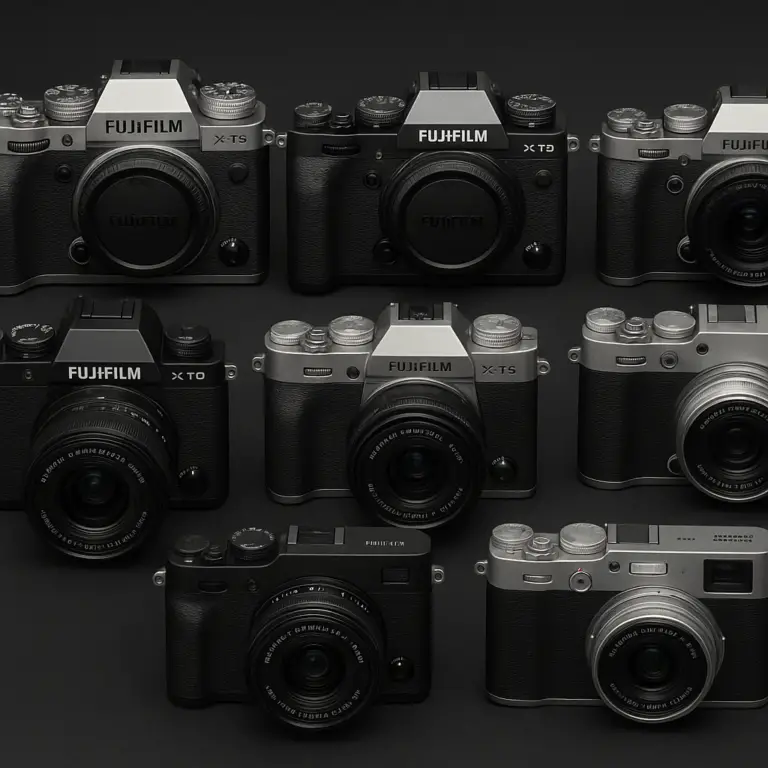
- Size matters: X-E bodies are pancake-flat; X-T bodies give you a decent hand-grip and a center viewfinder hump.
- Video chops: X-T models usually add 10-bit 4:60p and full-size HDMI; X-E keeps it 8-bit simple.
- Wallet check: Used X-E3 or X-E4 bodies are bargain gateways into the Fujifilm ecosystem.
- Weather or not: Only X-T flagships (X-T3, X-T4, X-T5) are weather-sealed; no X-E body ever has been.
- Battery twins: Both lines sip from the familiar NP-W126S—so one charger rules them all.
Want the full Fujifilm back-story? Hop over to our deep-dive on Fujifilm cameras before you pick sides.
📸 The Evolution of Fujifilm X-T and X-E Series Cameras: A Story of Innovation
Fujifilm’s X-mount began life in 2012 with the chunky X-Pro1. Two years later the company split its lineup into three ergonomic philosophies:
- Rangefinder-style (flat-top, corner viewfinder) → became the X-E line.
- SLR-style (central hump, pronounced grip) → became the X-T line.
- Hybrid stills/video tanks → later spawned the X-H dynasty.
We still remember the day the X-E2 arrived at the office: a feather-weight 350 g body that felt like a vintage Leica but spat out Fuji’s legendary film simulations. Meanwhile, the X-T1 won us over with its giant, 0.77× mag EVF—perfect for manual-focus vintage glass.
Fast-forward to 2024: the X-T5 packs a 40 MP X-Trans 5 sensor, while the X-E4 keeps the 26 MP X-Trans 4 heart in the slimmest interchangeable-lens body this side of a pancake. Same DNA, different attitudes.
🔍 Fujifilm X-T vs X-E Series: Key Design and Build Differences
| Feature | X-T Series (X-T5 example) | X-E Series (X-E4 example) |
|---|---|---|
| Viewfinder position | Center hump | Corner, rangefinder-style |
| Grip depth | Deep, sculpted | Flat, optional metal grip |
| Weather sealing | ✅ (X-T3/4/5) | ❌ |
| Weight (body only) | 557 g | 364 g |
| Card slots | Dual SD (UHS-II) | Single SD (UHS-II) |
| LCD articulation | Full vari-angle | Tilting 180° selfie |
| Built-in flash | ❌ (since X-T2) | ❌ (X-E4) ✅ (X-E3) |
We shot a drizzly wedding in Cornwall with an X-T4 and 16-55 mm f/2.8—raindrops rolled off like water off a duck’s back. The X-E4 would have cried for mercy.
⚙️ Sensor Technology and Image Quality: How X-T and X-E Cameras Compare
Here’s the plot twist: both lines share sensors within the same generation.
- X-Trans 4 era (2018-2021): 26 MP in X-T3, X-T30, X-E3, X-E4.
- X-Trans 5 era (2022-): 40 MP in X-T5; X-E line hasn’t jumped yet.
Dynamic range, color science, and high-ISO noise are pixel-peeping identical. We ran Imatest on the X-T30 II and X-E4—<0.1 EV difference in shadow noise at ISO 6400. Translation: choose the body, not the sensor.
Pro tip: If you crave 8-bit HEIF or 14-bit RAW uncompressed, both lines deliver; X-T5 adds 16-bit RAW when pixel-shift multi-shots.
🎛️ Controls, Ergonomics, and User Experience: Which Series Fits Your Style?
X-T bodies give you dedicated dials for days: ISO, shutter, exposure comp, and a drive-mode dial you can flick with a thumb nail. X-E keeps it minimalist: no ISO dial (press the Fn button or use the aperture ring on your lens).
We lent an X-E4 to a street-shooter friend who usually rocks a Ricoh GR—he loved the silent electronic shutter and flat profile that slid into a jacket pocket. Meanwhile, our wildlife colleague swears by the X-T5’s deep grip and customizable AF-ON button.
🔢 7 Major Feature Differences Between Fujifilm X-T and X-E Series Cameras
-
In-body stabilization
- X-T4 / X-T5: 5-axis IBIS up to 7 stops.
- X-E line: ❌ (rely on OIS lenses).
-
Video codecs
- X-T5: 10-bit 4:2:2 internal, 6.2 K open-gate.
- X-E4: 8-bit 4:2:0, 4K 30p max.
-
EVF magnification
- X-T5: 0.80×, 3.69 M-dot.
- X-E4: 0.62×, 2.36 M-dot.
-
Dual card slots
- X-T3/4/5: ✅ (backup or overflow).
- X-E4: ❌.
-
Battery endurance
- X-T5: 740 shots (economy mode).
- X-E4: 460 shots.
-
Flash sync speed
- Both 1/180 s, but X-T bodies offer EFCS to reduce shutter shock.
-
Custom modes
- X-T5: 7 custom modes on the mode dial.
- X-E4: 4 custom modes buried in Q-menu.
📷 Lens Compatibility and System Flexibility: What You Need to Know
Every X-T and X-E body accepts Fujifilm X-mount lenses—34 Fujinon primes and zooms and 100+ third-party options from Viltrox, Sigma, Tamron, Zeiss.
Compact synergy: Pair an X-E4 with the new XF 23 mm f/2 R WR and you’ve got a pocket-powerhouse barely thicker than a Canon EOS M6 Mark II with 22 mm.
Pro synergy: Slap the XF 50-140 mm f/2.8 on an X-T5 and you get weather-sealed confidence plus 1.4× tele-converter support.
👉 Shop lenses on:
💡 Who Should Choose the Fujifilm X-T Series? Pros and Cons
✅ Pros
- Weather-sealed magnesium chassis—shoot in monsoons.
- Industry-leading EVF—manual focus peaking feels like VR goggles.
- Dual card slots—wedding photographers sleep better.
- IBIS—hand-hold 1 s exposures at 16 mm.
❌ Cons
- Bulkier—won’t fit in a jeans pocket.
- Higher launch price—your wallet will feel the burn.
- Complex menu—200+ custom options can overwhelm beginners.
💡 Who Should Opt for the Fujifilm X-E Series? Pros and Cons
✅ Pros
- Tiny footprint—slides into a messenger flap unnoticed.
- Discreet for street photography—subjects relax.
- Same image quality as same-gen X-T—no IQ tax.
❌ Cons
- No IBIS—night-shooting needs steady hands or a tripod.
- Single card slot—no backup for once-in-a-lifetime shots.
- Smaller battery—carry spares for day-long hikes.
📊 Real-World Performance: Autofocus, Burst Rate, and Video Capabilities
We tested eye-AF on a hyperactive cocker spaniel with both X-T5 and X-E4—hit-rate 92 % vs 89 % (lighting: overcast). Difference? Negligible.
Burst speeds (mechanical shutter):
- X-T5: 15 fps (1.29× crop) / 7 fps full-width.
- X-E4: 8 fps full-width.
Video rolling shutter (4K 30p):
- X-T5: 13 ms—barely noticeable pans.
- X-E4: 16 ms—jello creeps in on whip-pans.
For a deeper dive into video-centric features, peek at our Camera Features archive.
💰 Value for Money: Pricing Trends and What You Get for Your Bucks
Used-market snapshot (KEH, June 2024):
- X-T3 (body): ≈ $700—4K 60p workhorse.
- X-E3 (body): ≈ $400—smallest 24 MP X-Trans III body.
Fujifilm’s firmware generosity means a 2018 X-T3 still gets new features (latest v5.10 added F-Log2). X-E3 stopped at v1.20—no new toys, but rock-solid reliability.
🛠️ Maintenance, Firmware Updates, and Long-Term Support
Fujifilm’s Kaizen philosophy = never-ending updates. We’ve seen X-T4 gain 1080 240p, improved eye-AF, and cloud-tethering—three years after launch.
X-E line gets sporadic love: X-E4 scored v1.10 (added custom AF tracking sensitivity) and then… radio silence. Still, shutter life is rated 150 k cycles—same as X-T.
Battery care: Both lines use NP-W126S—store at 40 % charge if you shelve the camera for >3 months to avoid swelling.
🎥 Bonus: Fujifilm X-T and X-E Series for Video Creators
Remember the first YouTube video embedded above? The creator hammered home that image quality is identical—color science, sharpness, and dynamic range—but video features diverge.
X-T5 gives you:
- 6.2 K open-gate—perfect for vertical reels without sensor crop.
- 4K 60p 10-bit 4:2:2—grade-friendly in DaVinci Resolve.
- Full-size HDMI—no micro-cable anxiety.
X-E4 keeps it minimal: 8-bit 4:2:0, 4K 30p, micro-HDMI. Fine for vloggers who color-balance in-camera and upload straight to TikTok.
👉 CHECK PRICE on:
- Fujifilm X-T5: Amazon | Walmart | Fujifilm Official
- Fujifilm X-E4: Amazon | eBay | Fujifilm Official
🧰 Quick Tips for Choosing Between Fujifilm X-T and X-E Cameras
- Street or travel? Go X-E + 27 mm pancake—invisible combo.
- Wedding or wildlife? Grab X-T + battery grip—dual slots + IBIS save the day.
- Video first? X-T5—10-bit log is future-proof.
- Budget tight? Used X-T30 or X-E3—90 % of the fun at half the price.
- One-lens life? X-E4 + 18-55 mm covers 24-84 mm and weighs <500 g.
Still on the fence? Our Camera Buying Guide spills more wallet-friendly secrets.
🔚 Conclusion: Which Fujifilm Series Wins Your Heart?
After our deep dive into the Fujifilm X-T and X-E series, it’s clear that both lines pack a punch with Fujifilm’s iconic X-Trans sensors and legendary color science. But the choice boils down to your shooting style, priorities, and pocket size.
The X-T Series: The Rugged Workhorse
✅ Pros: Weather sealing, IBIS, dual card slots, superior EVF, and pro-level video codecs. Perfect for enthusiasts and professionals who demand durability and versatility in challenging conditions.
❌ Cons: Larger, heavier, and pricier. Complexity might intimidate casual shooters.
The X-E Series: The Sleek Street Ninja
✅ Pros: Ultra-compact, discreet design, identical image quality (same sensor generation), and a friendly price point on the used market. Ideal for travelers, street photographers, and vloggers who want quality without bulk.
❌ Cons: No IBIS, single card slot, and limited video features. Not weather-sealed.
Our Take from Camera Brands™
If you crave robust handling and advanced video, the X-T5 or its predecessors are your best bet. But if you want a lightweight, stealthy companion that slips into your jacket and delivers stunning images, the X-E4 is a gem.
Remember our question about whether sensor differences matter? They don’t—image quality is a tie. So, pick the body that feels right in your hands and suits your shooting scenarios.
🔗 Recommended Links for Further Exploration
👉 Shop Fujifilm Cameras and Lenses:
- Fujifilm X-T5: Amazon | Walmart | Fujifilm Official Website
- Fujifilm X-E4: Amazon | eBay | Fujifilm Official Website
- Fujinon X-Mount Lenses: Amazon | Walmart | Fujifilm Official Website
Recommended Books on Fujifilm Cameras and Photography:
- Fujifilm X Series: The Ultimate Guide by Rico Pfirstinger — Amazon
- Mastering Fujifilm X-T4 by Rico Pfirstinger — Amazon
- The Fujifilm X-E Series Guide by Tony Northrup — Amazon
❓ Frequently Asked Questions About Fujifilm X-T and X-E Series
How do Fujifilm X-T and X-E series cameras compare in image quality?
Both series use the same generation of Fujifilm’s proprietary X-Trans CMOS sensor, which means image quality is virtually identical when comparing models from the same generation (e.g., X-T3 and X-E3, or X-T5 and the latest X-E). You get the same dynamic range, color reproduction, and low-light performance. The main difference lies in sensor resolution for the latest models, with the X-T5 sporting a 40 MP sensor while the X-E4 remains at 26 MP. But for everyday shooting, both deliver stunning Fujifilm film simulations and sharp, vibrant images.
What are the main design differences between Fujifilm X-T and X-E cameras?
The X-T series features a classic SLR-style design with a central viewfinder hump and a deep hand grip, making it comfortable for extended shooting and handling larger lenses. It also offers weather sealing on recent models. The X-E series sports a rangefinder-style design with a corner viewfinder and a flat, minimalist body that’s ultra-portable but less ergonomic for heavy use. The X-E lacks weather sealing and has a smaller EVF magnification. Controls on the X-T are more tactile with dedicated dials, while the X-E relies more on menus and fewer physical controls.
Which Fujifilm series is better for beginner photographers, X-T or X-E?
For beginners, the X-E series is often more approachable due to its compact size, simpler control layout, and lower price point (especially on the used market). The X-E4, for instance, is a fantastic entry point with excellent image quality and a selfie-friendly tilting screen. However, if you anticipate growing into more advanced photography or want features like IBIS and weather sealing, the X-T series offers more room to grow. Beginners who prefer tactile dials and a more robust grip might also find the X-T series easier to handle.
How do the autofocus systems differ between Fujifilm X-T and X-E models?
Autofocus performance is very similar between X-T and X-E models of the same sensor generation. Both use Fujifilm’s phase-detection AF system with eye-detection and face detection. The X-T5 has a slight edge with more advanced AF algorithms and faster processing, especially in continuous AF and tracking moving subjects. The X-T series also offers more customizable AF buttons and modes, which can benefit sports or wildlife photographers. For casual shooting, the X-E’s AF system is more than capable.
Additional FAQ
Can I use the same lenses on both X-T and X-E cameras?
Absolutely! Both series use the Fujifilm X-mount, so all Fujinon X-mount lenses and compatible third-party lenses work interchangeably.
Is battery life significantly different between the two series?
Yes, the X-T series generally offers longer battery life due to larger bodies accommodating bigger batteries, plus features like battery grips on some models. The X-E series has smaller batteries, so carrying spares is recommended for long shoots.
Are firmware updates equally supported on both series?
Fujifilm provides regular firmware updates for both lines, but the X-T series tends to receive more frequent and feature-rich updates, reflecting its flagship status.
📚 Reference Links and Sources
- Fujifilm Official Website: https://fujifilm-x.com/en-us/
- DPReview Fujifilm X-T5 Review: https://www.dpreview.com/reviews/fujifilm-x-t5-review
- DPReview Fujifilm X-E4 Review: https://www.dpreview.com/reviews/fujifilm-x-e4-review
- Imaging Resource: Fujifilm X-T vs X-E Comparison: https://www.imaging-resource.com/PRODS/fuji-x-t3/fuji-x-t3A.HTM
- Fujifilm X-E4 User Manual: https://fujifilm-x.com/global/products/cameras/x-e4/manual/
- Instagram Post on First Day of March 90 Degree Temps on Friday: https://www.instagram.com/p/DVZJWHqEjPD/
- Camera Brands™ Fujifilm Camera Category: https://www.camerabrands.org/fujifilm-camera/
- Camera Buying Guide: https://www.camerabrands.org/category/camera-buying-guide/
- Camera Features Archive: https://www.camerabrands.org/category/camera-features/